This year, while preparing the new catalog, we spent a lot of time on terraces, courtyards, and balconies. Not for photography, but because we wanted to see how people actually use plant containers in everyday life. Some use them to block the view of the street, others to divide space on a hospitality terrace, and others simply look for something beautiful for the entrance area. And honestly, that is exactly where you can best see what works and what doesn’t.
In the 2026 catalog of plant containers, we have therefore gathered models that are not made only for photographs. These are containers that remain beautiful even after several outdoor seasons. Rain, sun, snow… all of this quickly reveals the true quality of materials in outdoor elements.
Outdoors, excess becomes obvious quickly
Sometimes a single well-placed planter is enough for a space to feel more organized. Everything does not need to be filled with decoration. Clean lines and a bit of greenery often achieve more than a pile of accessories. At Flamula, we therefore stayed with very clean forms—without unnecessary details and without visual chaos.
Such plant containers easily fit both modern houses and more traditional facades. Many people tell us they like the fact that the plants stand out more: the container does not take over the space, but complements it.
Material makes a huge difference
This usually becomes noticeable only over time. At the beginning, almost every container looks good. After two winters, however, the story is often different. In our models, we use galvanized steel, aluminum, stainless materials, and corten steel. We wanted something that can withstand harsher winters or terraces exposed to sun all day.
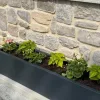
What we especially like about metal containers is their stability: they do not warp, swell, or absorb moisture. Even the edges remain straight, which is not obvious in larger dimensions. Powder coating according to the Qualicoat standard ensures that the color remains consistent over the years. Nobody wants a planter that looks faded after one summer.
People often only realize at the end what size they need
This is probably one of the most common things in outdoor space planning. At first, everyone thinks about color and plants, and only later comes the question of size. That is why we included a wide range of dimensions in the catalog: smaller containers for balconies, longer models for terraces, taller versions for space division or added privacy.
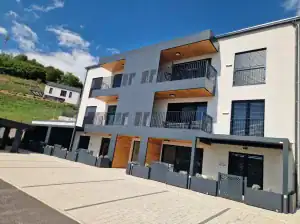
Standard sizes are available, from shorter 30 cm models to larger containers up to 160 cm in length. If a space requires something special, we also produce custom-made containers. This is especially useful for hotels, hospitality areas, or modern new builds where standard dimensions simply do not fit well.
They stay outside all year round
Some people still store their containers in garages or under shelters during autumn. With metal containers, this is actually not necessary. Our models are designed for year-round use. Snow, ice, and rain do not cause any problems. Even in summer, when the sun hits the surface for hours, the material remains stable. This is one of those things you may not notice in the first month—but you definitely do after a few years. Especially with larger containers, the difference becomes clear quickly. Lower-quality materials start to crack or lose their shape. Metal construction remains far more reliable.
Larger containers are becoming increasingly popular
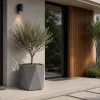
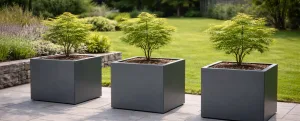
A few years ago, people mostly looked for smaller flower containers. Today, larger containers with ornamental grasses, olive trees, or even small trees are increasingly used. Such arrangements quickly change the feeling of a space: terraces feel more defined, balconies more homely, and gardens more cohesive.
This year we included quite a few solutions where containers are not just “plant pots,” but an actual part of the ambiance. Some use them to divide restaurant seating areas, others for privacy near pools. And honestly, that is where metal really stands out.
Color choices are becoming simpler
We also noticed something interesting: most people today choose very calm tones—black, anthracite, dark grey, sandy shades. These colors are less tiring over time, and plants stand out more. Corten steel remains a special story: some love it precisely for its slightly raw look, which pairs well with wood, stone, or concrete. It is not for every space, but where it fits, it looks excellent.